
The Animals Aren't Alright

Most political and ethical positions have compelling arguments coming from each side, but not factory farming. “The question we face is whether we should torture billions of sentient beings before killing them because we like the taste of their flesh.” (Bentham’s Bulldog)
Should pigs (who are smarter than dogs) be lowered screaming into CO2 gas chambers that burn their eyes, nostrils, throats and lungs as they asphyxiate?
Should piglets have their tails cut off with pliers, teeth ground down and testicles ripped out with no anesthesia? (The tail docking is because pigs bite each other’s tails from stress when packed in concrete pens.)
Questions like these are as close to no brainers as it gets.
Should farmers use pliers to pull skin off live fish? Should dozens be crammed into buckets as they grasp for oxygen and die of asphyxiation?
Should we suffocate, gas or grind 350 million male chicks to death every year (in the US alone) because they don’t lay eggs?*
If we were the people we wished we were, if we knew more, thought faster, became more rational, how would we answer these questions? Neither individually or collectively does our treatment of animals make any sense.
*Male chicks killed at birth are the lucky ones. Their sisters often spend their lives in battery cages or in windowless sheds rotting in their own shit. Enter an egg laying barn and every sense you have will be accosted by suffering: you will hear nothing but screams, the only detectable smell will be of feces and ammonia, and your eyes will see nothing other than death and disease.
This is just a fraction of the tortures we inflict on hundreds of billions, and practices like this are the norm, not the exception. Factory farming is a clear candidate for the biggest moral mistake humanity is currently making. The scale of the problem is so large that it’s impossible to intuitively grasp. Farm animals are literally the epitome of “one death is a tragedy but 1 million is a statistic.” The vast majority of animals we eat (most estimates are above 95%) come from factory farms, spending entire lives under conditions we can scarcely imagine.
There is total moral confusion in our laws, norms and culture over the rights of animals. Lewis Bollard on Dwarkesh Patel podcast gives Cockfighting as an example, a true evil afflicting thousands of chickens, has had multiple laws passed against it, is a felony in every state, and has been rightfully regulated out of existence. Yet when factory farmers do far worse, to a far greater number of chickens, we call that commerce. Torturing animals is cruel, illegal, and barbaric, that is unless you scale it up to billions of animals to sell their flesh.
If someone tortures their pet, they are universally condemned; but when a hundred billion animals are slain per year nobody cares much. Complain and you’re a radical, judgmental vegan nut. The sane and normal position is to look away.
Kristy Noem shot a dog and millions were outraged. South Park devoted an episode to her. She obviously acted wrong in killing it. Yet we routinely excuse torture and killing on a scale beyond our comprehension. Our only excuse is that it tastes nice and we don’t have to watch how it’s made. How in the world is it normal for someone to pay for chickens, pigs and cows to be tortured, mutilated and killed?
What should you do?
First, if you want to understand the horrors of factory farming, watch Dominion. I also recommend this debate, and the most important speech you will ever hear.
Second, consider reducing or eliminating your support for the practice. More people should go vegan, but if you don’t want to, consider reducitarianism, marginally changing your habits (eg order tofu pad thai instead of chicken)

99% of cheap meat comes from factory farms. The field of nutrition has confirmed to us that the optimal amount of meat, especially processed meat, in our diets is ZERO.
In the U.S. the number of cage free eggs has jumped from 10% to 40% in the past 20 years (which is great!) There are avenues other than advocacy or diet choices that can improve animal welfare.
Third, and this will in expected value be more effective than the first two, consider donating to reduce the suffering of factory farmed animals.
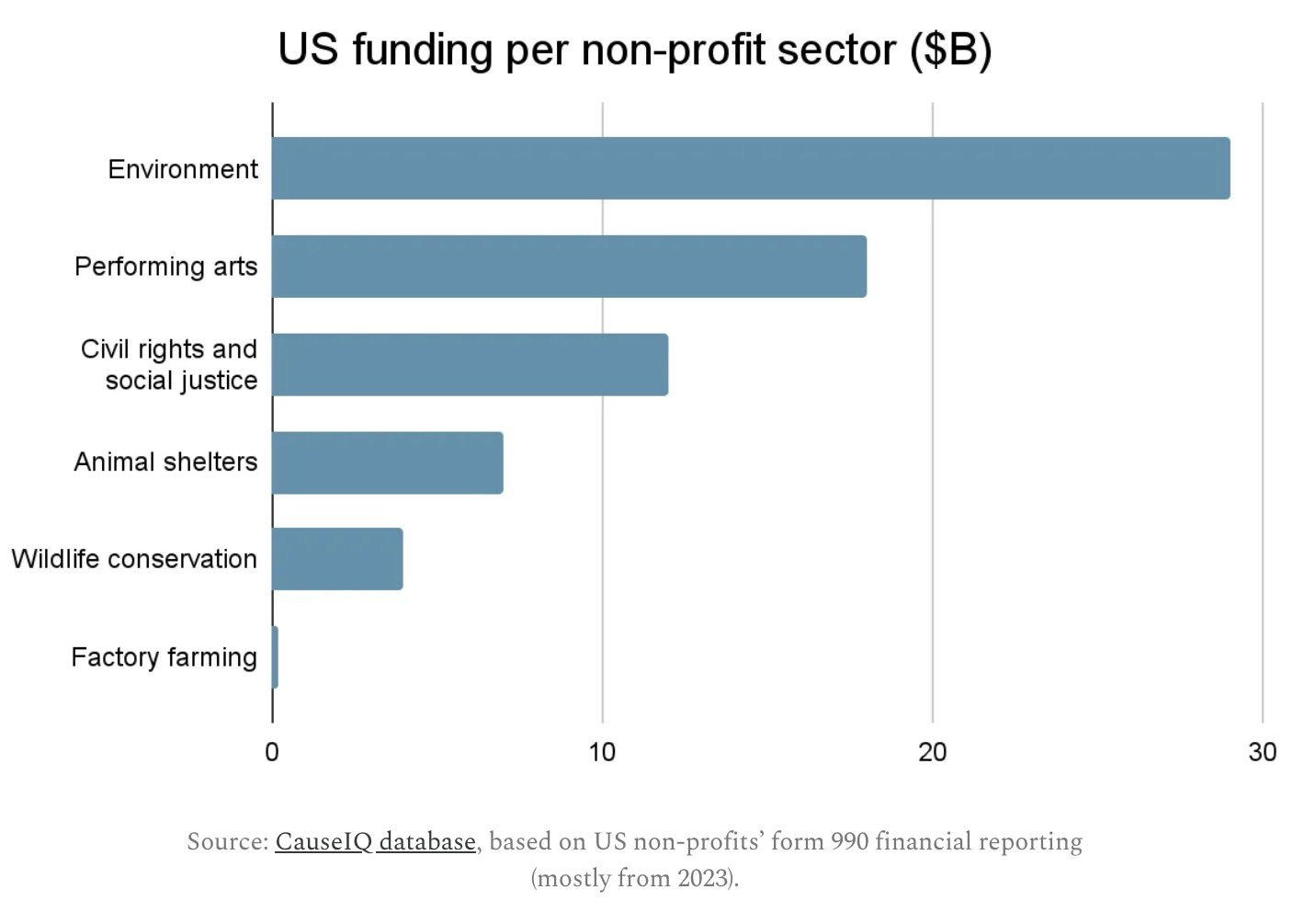
Factory farmed animals are likely the most neglected sentient beings on earth. Relative to other social causes, factory farmed animal welfare receives pitiful attention. Charities receive only ~200M/year in funding, compared to >3B for animal shelters (15x more). Meanwhile, at any given time there are 10 billion animals in factory farms in the US, and under 6 million in animal shelters. The best charity is probably not what you think.
Dwarkesh Patel just released a podcast on the most cost effective charities to reduce animal suffering. He’s currently running a fundraiser and matching donations to Farmkind. Farmkind works through realistic reform avenues: corporate campaigns, legislative advocacy and institutional change to end this nightmare. A few weeks ago I gave $1,000, and multiple friends and coworkers I’ve shared this with have already contributed several thousand more.
consider different foods
Eating animals is bad, but this does not mean that all animal foods are equally bad, and by my estimates the variance is extremely high! For example, if you got all of your protein from cows, you would probably go through less than 1 cow per year because they are massive. On the other hand, if you only ate chicken, you’d eat ~250 animals! One cow provides ~500 lbs of meat; one chicken provides ~3 lbs. If we’re comparing pasture raised cows (who have access to the outdoors for most of their lives) to factory farmed chickens, choosing beef is almost certainly preferable. Factory farmed chickens are some of the worst treated animals. They have their sensitive beaks seared off (so they don’t peck their neighbors), they develop osteoporosis because they’ve been bred for size, their brothers are all macerated after hatching, and worst of all, even ‘cage free’ often live tightly packed in sheds with less than a square foot of space to themselves (source).
If you’re trying to reduce suffering, you can:
avoid farmed animals, eat wild caught fish, pasture raised beef, etc. The difference in welfare between a hen with 100 square feet (certified pasture raised) of space vs. 1 square foot is massive.
Consider oysters, mussels, and other bivalves. According to most theories of consciousness, they are quite unlikely to be sentient (I estimate >95% chance they lack any experience). They have very few neurons (~20,000, for comparison, fruit flies have 5x as many), no centralized brain, no pain receptors and there’s no evidence of pain avoidance. They also live completely immobile lives, such that modern farming practices are nearly identical to their evolutionary environment. Interestingly, they’re also environmentally beneficial because they improve water quality through filter feeding. (They also have omega-3’s and vitamin B-12, so they make a nutritious addition to a vegan diet)
Be careful what you eat; if sentient, even shrimp live terrible lives. Their eyes are squished (eyestock ablation) and live tightly packed with other shrimp. Also the number of deaths per calorie is high, because they are small.
Other Sources:
https://www.effectivealtruism.org/articles/cause-profile-animal-welfare
https://www.givingwhatwecan.org/cause-areas/animal-welfare
